mirror of
https://github.com/dotnetcore/FreeSql.git
synced 2026-02-03 06:50:53 +08:00
13
LinqToSql
AlexLEWIS edited this page 2021-09-27 13:57:20 +08:00
中文 | English
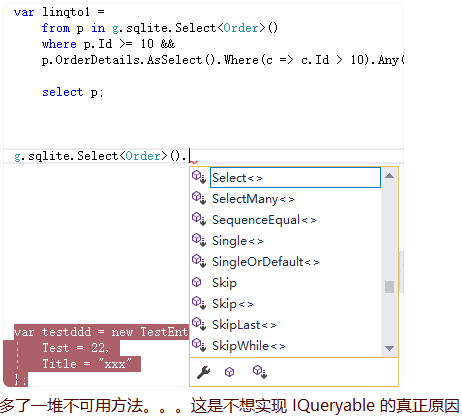
原本不支持 IQueryable 主要出于使用习惯的考虑,编写代码的智能总会提示出现一堆你不想使用的方法(对不起,我有强迫症),IQueryable 自身提供了一堆没法实现的方法,还有外部入侵的扩展方法,严重影响编码体验。如下图:
v1.4.0+ 版本请使用以下命令安装(老版本不需要安装):
dotnet add package FreeSql.Extensions.Linq
特别说明
-
请尽量不要在 ISelect 模式下的使用 Linq 方法:GroupJoin、Select、SelectMany、Join、DefaultIfEmpty;
-
如果一定要在 ISelect 中使用 .Select() 方法,请务必在 .ToList() 之前调用它;
IQueryable
FreeSql 提供强大的数据查询对象 ISelect。
FreeSql.Extensions.Linq v1.4.0+ 实现了 IQueryable 查询对象常用功能,以便在各框架中交互使用。
//将 ISelect 转为 IQueryable
IQueryable<Student> queryable = fsql.Select<Student>().AsQueryable();

//Linq 方法查询
var t1 = queryable.Where(a => a.id == 1).FirstOrDefault();

//将 IQueryable 还原为 ISelect
ISelect<Studeng> select = queryable.RestoreToSelect();
注意:IQueryable 的实现目前不支持 GroupBy,可以考虑使用 RestoreSelect 方法转回 ISelect 进行查询
Where
var t1 = (
    from a in fsql.Select<Student>()
    where a.id == item.id
    select a
).ToList();
Select(指定字段)
var t1 = (
    from a in fsql.Select<Student>()
    where a.id == item.id
    select new { a.id }
).ToList();
CaseWhen
var t1 = (
    from a in fsql.Select<Student>()
    where a.id == item.id
    select new {
        a.id,
        a.name,
        testsub = new {
            time = a.age > 10 ? "大于" : "小于或等于"
        }
    }
).ToList();
Join
var t1 = (
    from a in fsql.Select<Student>()
    join b in fsql.Select<School>() on a.id equals b.StudentId
    select a
).ToList();

var t2 = (
    from a in fsql.Select<Student>()
    join b in fsql.Select<School>() on a.id equals b.StudentId
    select new { a.id, bid = b.id }
).ToList();

var t3 = (
    from a in fsql.Select<Student>()
    join b in fsql.Select<School>() on a.id equals b.StudentId
    where a.id == item.id
    select new { a.id, bid = b.id }
).ToList();
LeftJoin
var t1 = (
    from a in fsql.Select<Student>()
    join b in fsql.Select<School>() on a.id equals b.StudentId into temp
    from tc in temp.DefaultIfEmpty()
    select a
).ToList();

var t2 = (
    from a in fsql.Select<Student>()
    join b in fsql.Select<School>() on a.id equals b.StudentId into temp
    from tc in temp.DefaultIfEmpty()
    select new { a.id, bid = tc.id }
).ToList();

var t3 = (
    from a in fsql.Select<Student>()
    join b in fsql.Select<School>() on a.id equals b.StudentId into temp
    from tc in temp.DefaultIfEmpty()
    where a.id == item.id
    select new { a.id, bid = tc.id }
).ToList();
From(多表查询)
var t1 = (
    from a in fsql.Select<Student>()
    from b in fsql.Select<School>()
    where a.id == b.StudentId
    select a
).ToList();

var t2 = (
    from a in fsql.Select<Student>()
    from b in fsql.Select<School>()
    where a.id == b.StudentId
    select new { a.id, bid = b.id }
).ToList();

var t3 = (
    from a in fsql.Select<Student>()
    from b in fsql.Select<School>()
    where a.id == b.StudentId
    where a.id == item.id
    select new { a.id, bid = b.id }
).ToList();
GroupBy(分组)
var t1 = (
    from a in fsql.Select<Student>()
    where a.id == item.id
    group a by new {a.id, a.name } into g
    select new {
        g.Key.id, g.Key.name,
        cou = g.Count(),
        avg = g.Avg(g.Value.age),
        sum = g.Sum(g.Value.age),
        max = g.Max(g.Value.age),
        min = g.Min(g.Value.age)
    }
).ToList();